Pest alerts · picture guide
Spot the pest
Real photos of the seven paddy pests and diseases the alerts check, with what to look for, where on the plant, when in the season, and what each is easy to mix up with. Not sure? Take a photo to the KVK.
Picture guide · 7 pests and diseases
The ones the pest alerts check
When the pest alerts say "watch" or "high", walk the field and compare what you see with these photos. Each entry says what to look for, where on the plant, when in the season, and what it is easy to mix up with.
- Yellow stem borer
- Gall midge
- Leaf folder
- Brown planthopper (BPH)
- Blast (leaf and neck)
- Sheath blight
- Bacterial leaf blight (BLB)
Not sure? Take a photo to the KVK. Take a clear photo of the damaged plant (or bring a sample) to KVK Koraput, the local farm science centre, or show it to the local agriculture officer. They can confirm the pest or disease and say what to do. All official contacts →
All photos are real photos with an open licence (free to reuse with credit), from Wikimedia Commons. Most were taken outside Koraput, so colours and sizes may differ a little in the field. No computer-drawn pictures are used. Facts come from the IRRI Rice Knowledge Bank (IRRI is the International Rice Research Institute) and the ICAR-NRRI bulletins (NRRI is India's National Rice Research Institute, Cuttack).
Insect · 1 of 7
Yellow stem borer
A small moth. Its caterpillars bore into the rice stem and eat it from the inside.
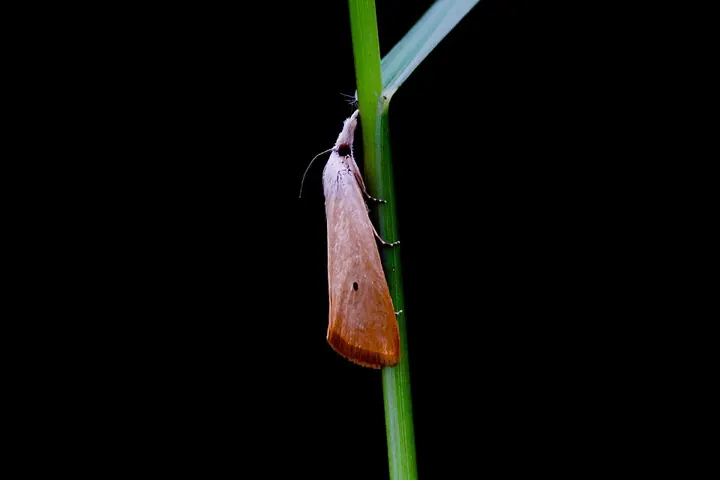
Photo: Md.Farhan Nabil · CC BY-SA 4.0 · source · resized

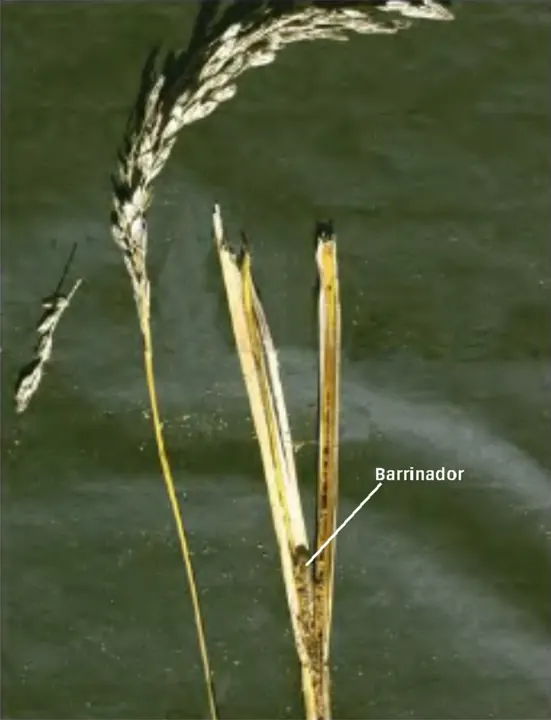
Photo: Miquel Pujol Palol · CC BY-SA 3.0 · source · resized

What to look for
- Young crop: a dried, brown centre shoot. It pulls out easily from the base. This is called a deadheart.
- After the ears come out: a white, empty ear that stands straight up, with no grain inside. This is called a whitehead.
- Tiny holes on the stem, and droppings inside the stem when you split it open.
Where on the plant: Inside the stem. The moths rest on the leaves.
When in the season: Any stage. Deadhearts while the crop is still putting out new shoots; whiteheads from ear forming to ripening.
Easy to mix up with: Rat damage, neck blast and black bug can also leave dead shoots or white ears. To be sure, pull a damaged stem and split it: a stem borer caterpillar or its droppings will be inside.
Source: IRRI Rice Knowledge Bank: stem borer. This week's alert level →
Insect · 2 of 7
Gall midge
A tiny fly. Its maggot feeds inside the growing tip of a shoot.
Photo coming
No openly licensed photo of this one was found yet, so this entry is words only. FarmBot does not use made-up or computer-drawn pest pictures.
What to look for
- A shoot that has turned into a hollow, silvery-white tube, about 1 cm wide and 10–30 cm long, instead of a leaf. It looks like an onion leaf, so it is called onion leaf or silver shoot.
- That shoot never makes an ear.
- Stunted plants with twisted or rolled leaves.
Where on the plant: At the base of the shoot, where new shoots grow.
When in the season: While the crop is still putting out new shoots. Cloudy, rainy weather suits it.
Easy to mix up with: Drought, potash shortage, salty soil, some virus diseases and thrips can also stunt plants or roll the leaves. Only gall midge makes the hollow silver tube; split it to find the small maggot.
Source: IRRI Rice Knowledge Bank: rice gall midge. This week's alert level →
Insect · 3 of 7
Leaf folder
A small moth. Its caterpillar folds a leaf around itself with silk and eats inside the fold.
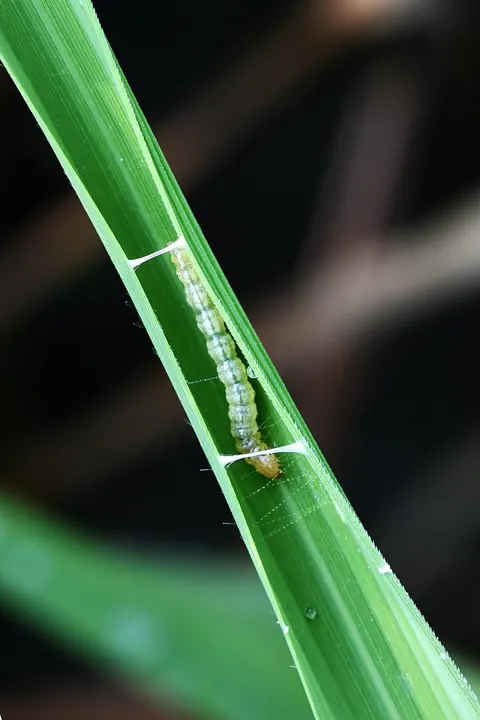
Photo: Badal Chandra Sarker · CC BY-SA 4.0 · source · resized

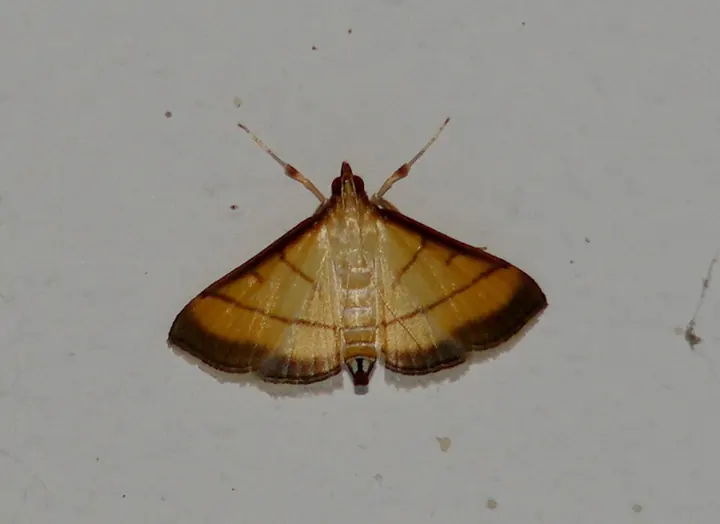
Photo: Haneesh K M. · CC0 · source · resized

What to look for
- Leaves folded lengthwise into a tube, with a green caterpillar inside.
- Long, white, see-through streaks on the leaf where the green part was eaten.
- In bad cases, the field looks scorched, with many folded leaves.
Where on the plant: On the leaves, most of all the youngest leaves and the top leaf (flag leaf).
When in the season: From when new shoots grow to flowering. Damage to the flag leaf at ear time matters most. More common in shady, heavily fertilised parts of the field.
Easy to mix up with: Gall midge and thrips can also roll leaves. Open the fold: a leaf folder fold has a caterpillar and silk inside.
Source: IRRI Rice Knowledge Bank: rice leaffolder. This week's alert level →
Insect · 4 of 7
Brown planthopper (BPH)
A tiny brown insect, about the size of a rice grain, that sucks sap at the base of the plants.
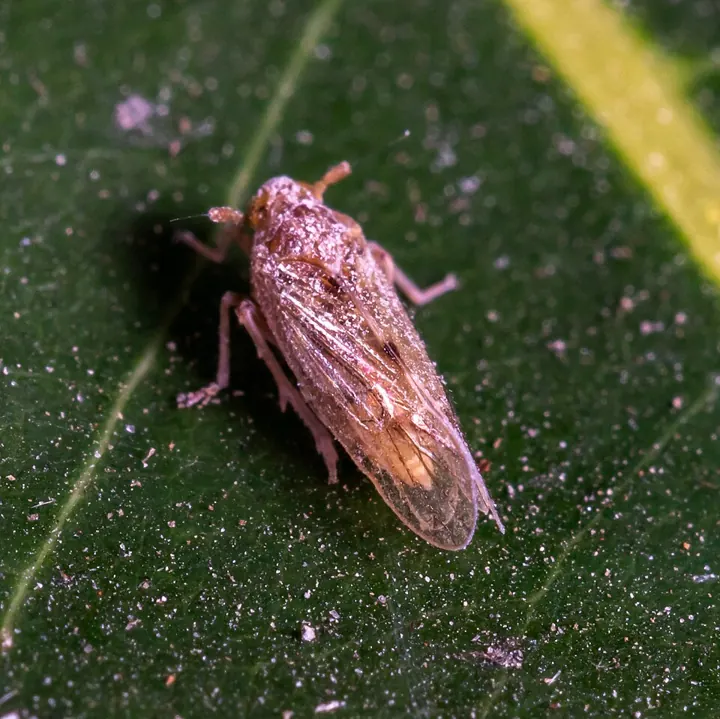
Photo: portioid · CC BY 4.0 · source · resized

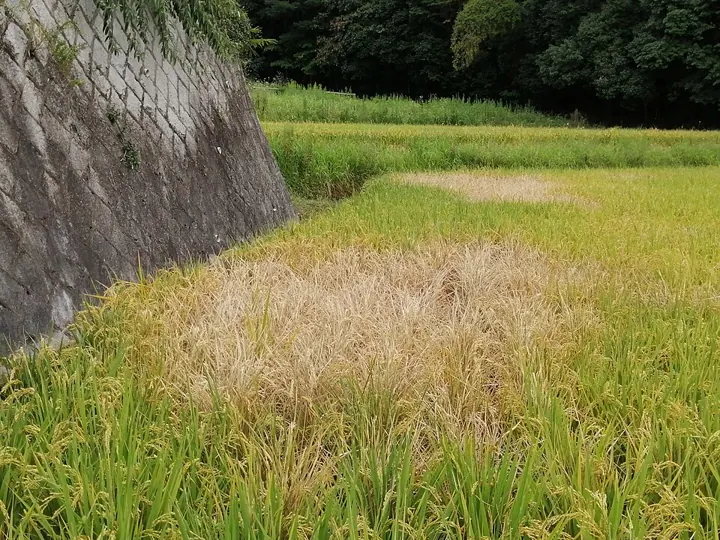
Photo: つくる暮らし · CC BY 2.0 · source · resized

What to look for
- Small brown insects at the base of the plants, just above the water. Bend a plant slightly and tap it near the base: they fall onto the water.
- Round patches where plants turn orange-yellow, then brown and dry, as if burnt. This is called hopperburn.
- Black sooty mould at the base of the plants.
Where on the plant: At the base of the stems, near the water. Not on the leaf tops.
When in the season: From the growing stage to the milk stage of the grain. Checking after the milk stage is not needed.
Easy to mix up with: Rice black bug can also dry plants in patches ("bugburn"). Look for the brown insects and the sooty mould at the base to be sure it is planthopper.
Source: IRRI Rice Knowledge Bank: planthopper. This week's alert level →
Disease · 5 of 7
Blast (leaf and neck)
A fungus disease. It can hit the leaves, the joints of the stem, and the neck just below the ear.
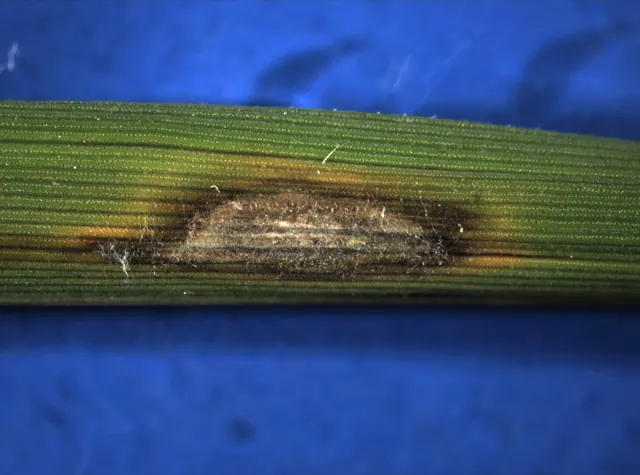
Photo: Yulin Jia, USDA Agricultural Research Service · public domain (US government work) · source · resized

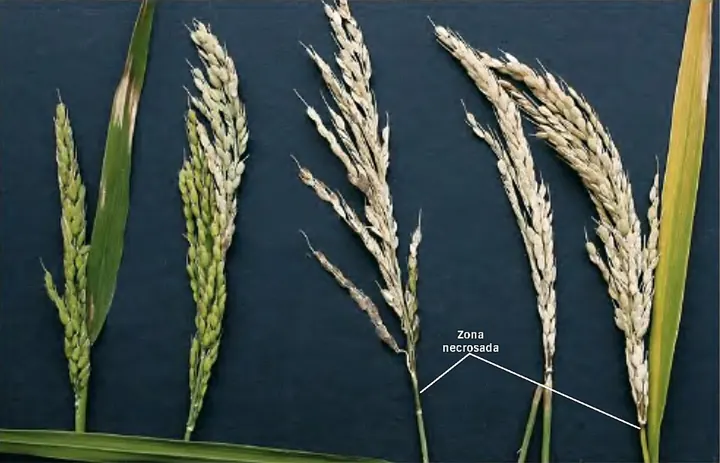
Photo: Miquel Pujol Palol · CC BY-SA 3.0 · source · resized

What to look for
- On leaves: eye-shaped or diamond-shaped spots, pointed at both ends, with a grey or whitish centre and a reddish-brown edge. New spots are small, grey-green with a dark green edge.
- Spots can join and kill the whole leaf.
- Neck blast: the neck just below the ear turns grey-brown and rots; the ear bends or breaks and stays empty or half-filled.
Where on the plant: Leaf spots on the leaves; neck blast at the top of the stem, just below the ear.
When in the season: Any stage. Leaf blast is worst on young crops; neck blast shows at flowering and grain filling. Long hours of wet leaves and cool nights suit it.
Easy to mix up with: Brown spot is the main look-alike: its spots are rounder, brown, and have a yellow ring around them. Blast spots are longer, pointed and grey in the middle.
Source: IRRI Rice Knowledge Bank: blast (leaf and collar) · ICAR-NRRI Technology Bulletin 277: rice blast. This week's alert level →
Disease · 6 of 7
Sheath blight
A fungus disease that starts low on the plant, near the water, and climbs up.
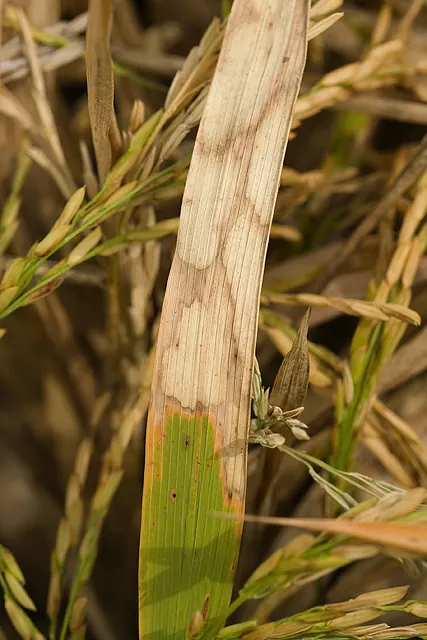
Photo: Peggy Greb, USDA Agricultural Research Service · public domain (US government work) · source · resized

What to look for
- Oval, grey-green patches, about 1–3 cm long, on the leaf sheath (the part that wraps the stem), just above the water line.
- The patches grow and climb to the upper sheaths and the leaves. Older patches have a grey-white centre and a brown edge, often in a wavy, map-like pattern.
- Small, hard brown lumps (the fungus's resting bodies) on or near the patches.
Where on the plant: Low on the stem, near the water line first, then higher up.
When in the season: From when new shoots grow to the milk stage. Hot, very humid weather, a thick crop and a lot of nitrogen fertiliser suit it.
Easy to mix up with: Stem rot and stem borer damage can look alike low on the stem. Sheath blight has the grey-white patches with brown, wavy edges, and the small brown lumps.
Source: IRRI Rice Knowledge Bank: sheath blight · ICAR-NRRI Technology Bulletin 279: sheath blight. This week's alert level →
Disease · 7 of 7
Bacterial leaf blight (BLB)
A disease caused by bacteria. It spreads fast after storms and heavy rain.
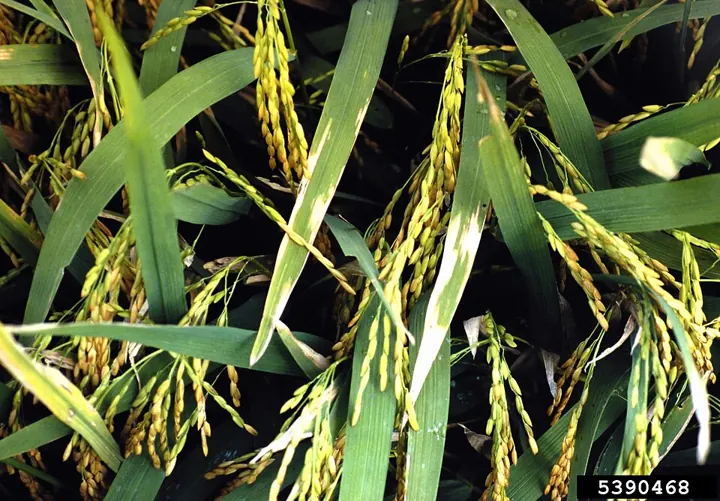
Photo: Donald Groth, Louisiana State University AgCenter, Bugwood.org · CC BY 3.0 us · source · resized

What to look for
- Yellow to straw-coloured stripes starting at the leaf tip or edge and running down the leaf, with a wavy edge.
- Early in the morning, small milky drops on young stripes; later they dry into tiny yellow beads.
- In young plants, leaves turn grey-green, roll up and the whole seedling wilts and dies (called kresek).
Where on the plant: On the leaf blades, from the tip and edges downwards.
When in the season: Any stage, worst when it starts early. Strong wind, heavy rain and a lot of nitrogen fertiliser favour it.
Easy to mix up with: Kresek can look like stem borer damage, but a kresek plant does not pull out easily. Quick test: cut a young stripe, stand it in a clear glass of water and hold it to the light. A cloudy stream from the cut end means bacteria.
Source: IRRI Rice Knowledge Bank: bacterial blight · ICAR-NRRI Technology Bulletin 276: bacterial leaf blight. This week's alert level →
Not sure? Take a photo to the KVK. Take a clear photo of the damaged plant (or bring a sample) to KVK Koraput, the local farm science centre, or show it to the local agriculture officer. They can confirm the pest or disease and say what to do. All official contacts →
FarmBot gives no spray doses. Ask KVK Koraput or the agriculture officer before spraying.