Pest and disease alerts · untested
Nilabadi pest alerts
This week's weather check for paddy pests and diseases across Nilabadi, by crop stage, with photos to spot each one. Rules from official sources only. Untested here: ask KVK Koraput before spraying.
Untested
Built from published weather rules, not yet checked against pest counts in Koraput. Not a forecast to act on alone; ask KVK Koraput before spraying.
Before spraying: KVK Koraput +91-7008930482, kvk.koraput@ouat.ac.in.
Crop loss, if insured under PMFBY: report within 72 hours on 14447.
Advice by phone: Kisan Call Centre 1800-180-1551 (6 AM–10 PM) / Krushi Samrudhi 155333.
Not sure which pest it is? Spot the pest has real photos of all seven, with what to look for and what each is easy to mix up with. Tap a small photo in the table below to go straight to that one. Still not sure? Take a photo to the KVK (KVK Koraput contacts).
Whole village · this week · 29 Oct – 4 Nov 2026 · updated 31 Oct 2026
This week in Nilabadi, by crop stage
The weather is much the same across Nilabadi's paddy fields, so the weather risk is shared. What changes from field to field is the crop's stage: some pests only do harm at certain stages. Find your crop's stage in the first column. Low = few weather signs. Watch = several signs, look in the field. High = most signs: walk the field this week and look closely. Estimate
| If your crop is… | Pests and diseases at risk this week | What to do |
|---|---|---|
| Just planted | High blast (leaf and neck) 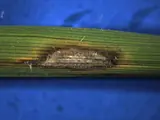 | Walk the field this week. Look for eye-shaped spots with grey centres on the leaves, and a grey-brown ring at the neck just below the ear (neck blast). |
| Young crop, still putting out new shoots | High blast (leaf and neck) Watch sheath blight 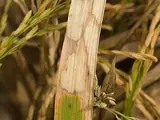 | Walk the field this week. Look for eye-shaped spots with grey centres on the leaves, and a grey-brown ring at the neck just below the ear (neck blast). |
| Ear forming or flowering | High blast (leaf and neck) Watch sheath blight | Walk the field this week. Look for eye-shaped spots with grey centres on the leaves, and a grey-brown ring at the neck just below the ear (neck blast). |
| Grain filling or ripening | Watch blast (leaf and neck) | On your next field walk, look for eye-shaped spots with grey centres on the leaves, and a grey-brown ring at the neck just below the ear (neck blast). |
| Ripe or harvested | Low nothing above low | No pest check needed. Harvest when 80–85% of grains are straw-coloured and hard. |
The weather this table uses is the forecast and recent weather at the points FarmBot follows in Nilabadi; where they differ, the higher level is shown. FarmBot does not yet know what stage each field in the village is at, so it shows every stage rather than a share of the village.
Why the weather suits these this week
- blast (leaf and neck): High weather. 4 of 4 weather signs seen (this week): nights 22-28 °C, 5+ days with leaves wet over 10 hours, long very humid spells (60+ hours above 95%), cloudy or drizzly week.
- sheath blight: Watch weather. 2 of 3 weather signs seen (this week): very humid (120+ hours above 85%), rain on 4+ days.
"Previous week" means the rule looks at last week's weather, as the published insect rules do. Humidity is how damp the air is. Leaf wetness is estimated from rain and damp air, not measured.
Fields that are followed closely get their own field-level alerts, with a card for every pest, on their plot pages. See the plots followed closely, or how to have a field followed.
Week by week
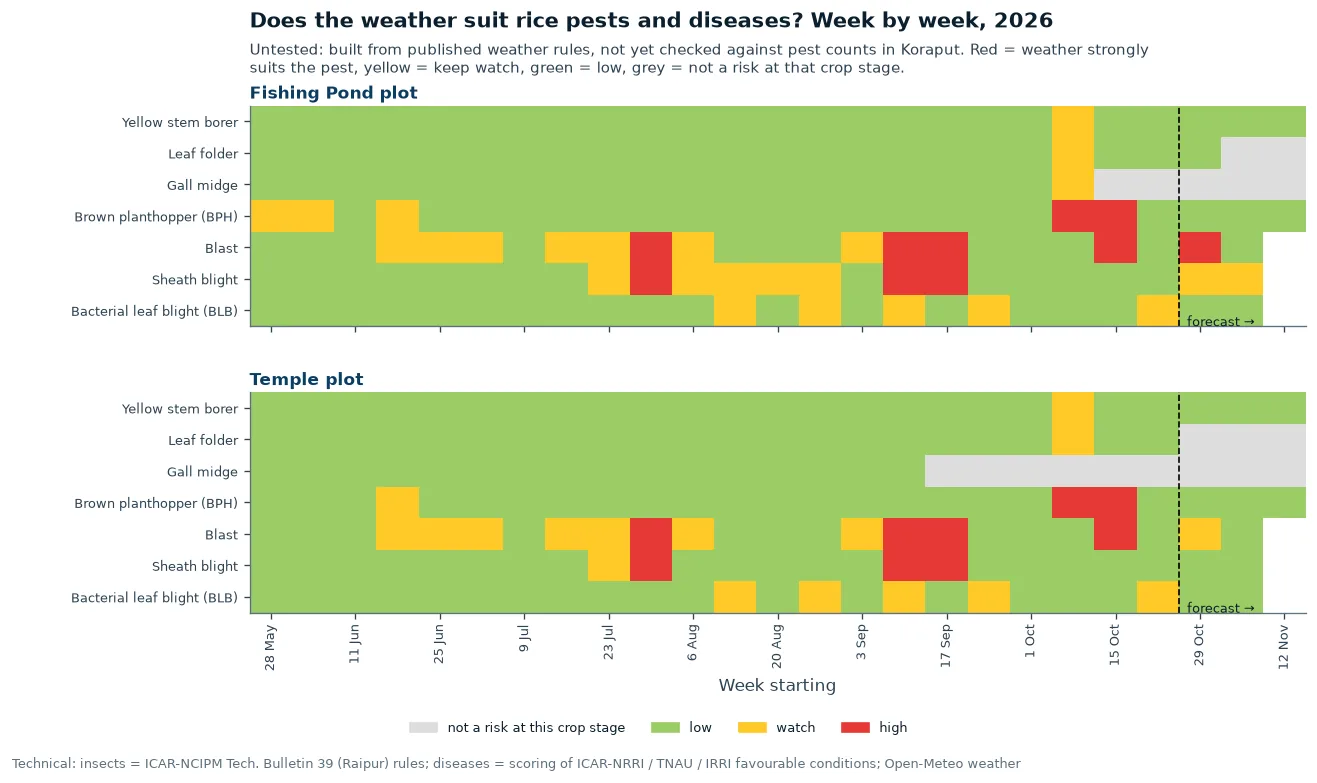
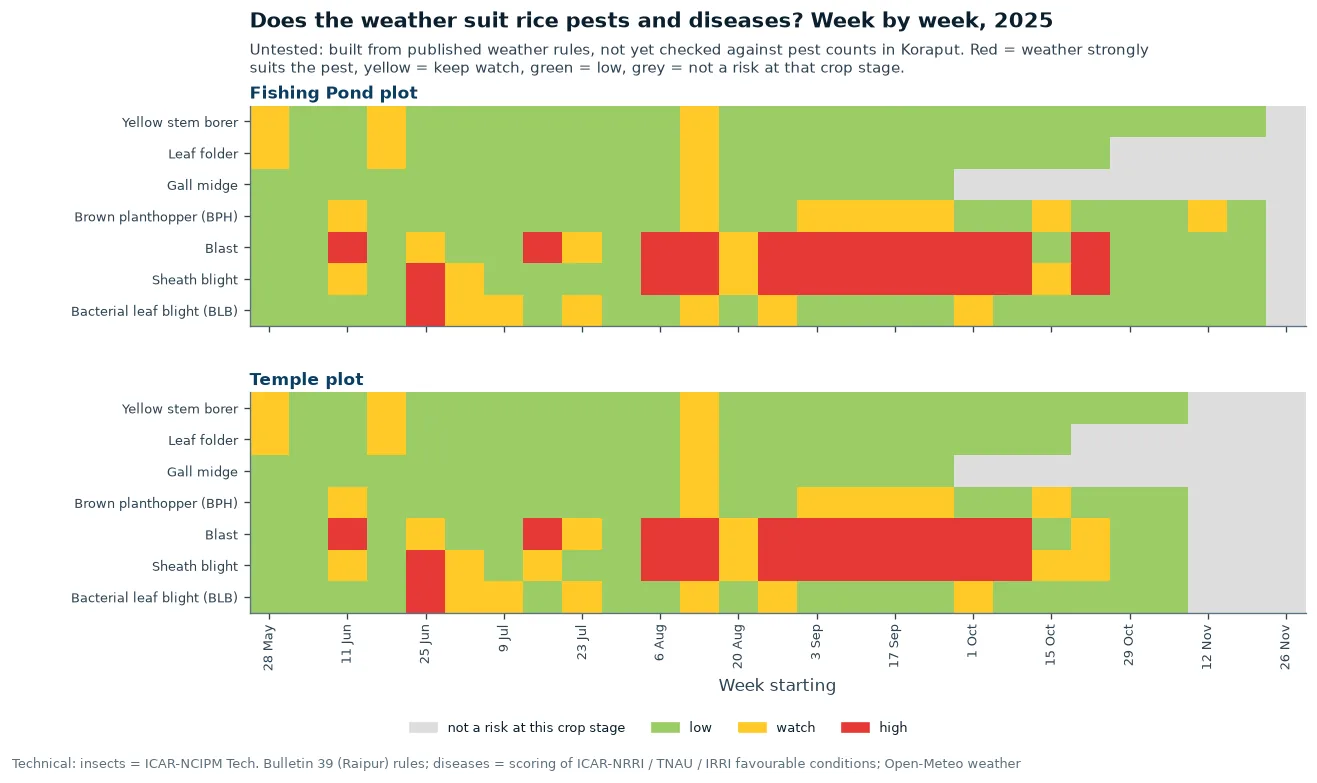
When the weather suited each pest
The same check run for every week of the 2025 and 2026 seasons, at the followed plots. This is how the rules will be tested: once there are field counts, we can see whether the red weeks really had more pests.
Untested
Built from published weather rules, not yet checked against pest counts in Koraput. Not a forecast to act on alone; ask KVK Koraput before spraying.
Field checks
What to look for in the field
The alerts only become trustworthy for Koraput once they are compared with what is actually seen in the fields. A simple weekly note (date, field, count) is enough. One season of notes would let us test the rules.
| What to check | How | When the number matters | Source |
|---|---|---|---|
| Stem borer and leaf folder moths | A light trap (a bulb over a pan of water) by the field, or 4-5 pheromone traps per acre (lure traps sold for "yellow stem borer" and "leaf folder"). Count the moths each morning and add them up for the week. | 4-5 male moths in one pheromone trap (NRRI). In the rule tables, 1 moth per square metre or 25 moths per trap per week. | NRRI advisory Oct 2026; NCIPM bulletin Annexure II |
| Dead hearts and white ears (stem borer) | Walk a diagonal across the field and look at 20 hills. Count dried central shoots (dead hearts) before flowering, and white empty ears after flowering. | 10% dead hearts at tillering; 2% white ears | NCIPM Annexure II |
| Folded leaves (leaf folder) | On the same 20 hills, count leaves rolled lengthwise with a caterpillar inside. | 2 damaged leaves per hill | NCIPM Annexure II; NRRI |
| Silver shoots (gall midge) | Before the ear forms, look for onion-leaf-like hollow tubes in place of a leaf. | 10% silver shoots, or 1 gall per square metre | NCIPM Annexure II |
| Planthoppers (BPH) | Bend 10-20 hills over the water and tap them near the base. Count the small brown insects that fall. Not needed after the grain turns milky. | 5-10 hoppers per hill (NRRI). Higher in the NCIPM tables (10-20 depending on stage). | NRRI advisory; IRRI; NCIPM |
| Blast | Look for eye-shaped spots with grey centres on leaves, and a dark ring at the neck below the ear. | 3-5 spots per leaf; 2-5 infected necks per square metre | NRRI Bulletin 277 |
| Sheath blight | Look low on the stems, near the water line, for oval grey-green patches with brown edges. | No number given; note how many hills have it | IRRI; TNAU |
| Bacterial leaf blight | Look for yellow-straw stripes with wavy edges running down from leaf tips, often after storms. | No number given; note how many hills have it | TNAU; IRRI |
The rules
Which pests and diseases matter here
These are the main paddy pests and diseases that research and official advice name for Koraput and Odisha. Each row says what weather suits it, and when farmers are told to act. The numbers in square brackets link to the sources at the bottom (who's who).
| Pest or disease | Evidence from Koraput and Odisha | Weather that suits it | Act when you see this in the field |
|---|---|---|---|
| Yellow stem borer Insect (moth caterpillar) | A serious pest of rice in Koraput [5]. Dried white rice heads caused by stem borer were seen in pest-control trials in Koraput [6]. It is on the rice institute's October 2024 Koraput watch list [4]. | A week with: day high 31–34 °C; night low 22–23 °C; morning humidity 89–92%; rain 0–10 mm; 6–9 hours of sunshine a day. If more than 3 of these 5 are true, many moths are likely. This rule was worked out for Raipur, Chhattisgarh, the nearest of the seven places where the pest centre studied it. [1] | 4–5 male moths caught per pheromone trap [3] |
| Gall midge Insect (small fly) | A serious pest of rice in Koraput [5]. | A week with: day high 31–34 °C; night low 20–23 °C; morning humidity 89–93%; rain under 10 mm; 8–9 hours of sunshine a day. More than 3 of 5 true = high risk. This rule was worked out for Raipur, Chhattisgarh, the nearest of the seven places where the pest centre studied it. [1] | As soon as the first damage is seen. No count is given [3] |
| Leaf folder Insect (moth caterpillar) | A moderate pest in Koraput [5]. On the rice institute's October 2024 Koraput watch list [4]. | The same weekly weather as stem borer, at Raipur. [1] | Two folded leaves per clump of plants [3] |
| Brown planthopper Insect (small sap-sucking bug) | A moderate pest in Koraput [5]. | A week with: average temperature 22–28 °C; average humidity 60–80%; rain under 25 mm; 8–9 hours of sunshine a day; wind 0–5 km/h. This rule was worked out for Raipur, Chhattisgarh, the nearest of the seven places where the pest centre studied it. The pest centre also notes that very humid air (above 85%) helped it build up. [1] | 5–10 hoppers per clump of plants [3] |
| Blast Fungus disease | The rice institute's October 2024 Koraput advice warned the weather may suit blast [4]. | Night temperature 22–28 °C; humidity above 95%; dew; leaves wet for more than 10 hours; cloudy or drizzly weather; a lot of nitrogen fertiliser in the soil. Most dangerous at the seedling stage, when new shoots form, and when the rice heads come out. [2] | On leaves: 3–5 spots per leaf. On the neck of the rice head: 2–5 sick plants per square metre [2] |
| Sheath blight Fungus disease | Named in the rice institute's fortnightly advice for all of Odisha [3]. | 28–32 °C with very humid air among the plants (above 96%); a lot of nitrogen fertiliser; close planting; frequent showers. Risky when new shoots form, when the ear is forming, and as the grain ripens. [7] | Act when it is seen on 1–2 shoots [3] |
| Bacterial leaf blight Bacterial disease | In the rice institute's October 2024 Koraput advice [4]. | 25–30 °C with high humidity, and cloudy, humid weather for 5 days or more. Strong wind, rain and deep water help it spread; a lot of nitrogen makes it worse. [8] | As soon as it appears. The rice institute also advises stopping extra nitrogen fertiliser [4] |
Day high and night low are the warmest and coolest temperatures of the day. Technical name: Tmax, Tmin, RH
Why these levels are untested
The insect rules were worked out from light-trap counts at Raipur and other places, and the disease rules from research write-ups. None has been checked in Koraput's hill climate, so the levels may warn too little or too much. Treat a high level as "go and look", not as proof of a pest.
How the check works
From weather to a level, step by step
1 · Weather
Forecast and recent weather
Hourly temperature, humidity, rain, wind and sunshine at each followed plot, from Open-Meteo Estimate. These become the weekly values the rules use.
2 · Wet leaves
Hours the leaves stay wet
Blast needs leaves to stay wet for more than 10 hours [2]. Until a leaf-wetness sensor is put in, wet hours are estimated from rain and very damp air.
3 · Crop stage
Crop stage
For the followed plots, the greenness score and the radar satellite give the crop's stage. For the rest of the village, find your own stage in the table at the top. Each pest is only checked at the stages when it does damage.
4 · Rules
Count the signs
For each pest, count how many of the listed weather signs the week meets, as the pest centre's rules do [1].
5 · Plan for 2027 · nothing installed
Sensors, traps and cameras
A rain gauge, smell-bait traps for stem borer moths and small solar light traps would replace the estimates with real counts [3]. Starter set about Rs 9,100–16,600. See the plan →
Sources
Where the rules come from
- ICAR-NCIPM (NICRA), Web enabled weather based prediction for insect pests of rice
- ICAR-NRRI (CRRI) Technology Bulletin 277, Rice blast disease and its integrated management
- ICAR-NRRI Agro-Advisory Service, first fortnight of September 2026
- ICAR-NRRI Agro-Advisory Service, October 2024 (district advisory incl. Koraput)
- Samir et al., J. Biopesticides 17(2):135–143 (2024), pest management in Koraput
- ICAR-IIRR, Demonstration of IPM practices in farmers' fields of Odisha (incl. Koraput)
- ICAR-NRRI Technology Bulletin 279 (2026), Rice sheath blight and its integrated management
- ICAR-NRRI Technology Bulletin 276 (2026), Integrated management of bacterial leaf blight of rice
- IMD Agromet Advisory Services, district advisories